November 17, 2026
- Running
- Training
- Health
Kneepainwhenrunning:whattodoandhowtogetbacktoit
Pain at the front of the knee is one of the most common complaints among runners. Sports medicine calls it patellofemoral pain syndrome; most people know it as runner's knee. The good news: in most cases, running itself is not the culprit — how the load is distributed is. The right exercises and a sensible break usually get you back to pain-free running.
What runner's knee is and how to recognise it
The pain comes from the soft tissue and bone around the kneecap when it doesn't glide smoothly as the knee bends and straightens. It usually affects one knee. Typical signs:
- a dull ache at the front of the knee, around or behind the kneecap;
- pain walking up and especially down stairs;
- pain when running, jumping, squatting or kneeling;
- discomfort after sitting for a long time with bent knees — in a car or at the cinema, for example;
- a popping or crackling feeling in the knee.
Women are about twice as likely as men to develop it — one reason is a wider pelvis, which changes the angle at the knee joint.
Why your knee hurts when you run
With every stride your knees absorb impact forces of up to four times your body weight, and they are sensitive to any change in that load. The main causes:
- A sudden jump in training. More miles, faster pace, new hilly routes — especially without strength work.
- Weak glutes and hip muscles. When the glutes don't control the pelvis and thigh, the knee caves inward and absorbs extra force.
- Tight muscles. Tight quads and IT band pull on the kneecap and disturb how it tracks.
- Form. Overstriding and landing hard on the heel far in front of your body increases stress on the front of the knee.
- Previous knee injuries or surgery.
What to do if your knee already hurts
Stopping all activity is usually unnecessary: properly dosed loading is part of the treatment. With early action, many runners return to normal training in about four to six weeks.
- Assess the pain. Mild soreness without sharp pain means it's time to adjust your training and start strengthening. Persistent pain during or after runs, swelling or weakness in the leg means it's time to see a doctor.
- Reduce the load. Run shorter and slower, and drop downhills for now — knees usually tolerate a slight incline better. Run/walk helps, and with stronger pain, walk only for a few weeks.
- Keep your fitness without impact. An indoor bike and swimming maintain endurance while the knee settles.
- Rest and ice often ease symptoms during a flare-up.
- Tape and braces may reduce pain but don't fix the cause. Without work on your muscles and training load, the problem is likely to return.
4 exercises for runner's knee
The main goal is strong glutes, thighs and core muscles that keep the knee in line with the foot. Move slowly and stay pain-free.
- Banded side taps. Put a mini band around your legs, stand tall and tap one foot out to the side while keeping your hips level. The lower the band, the harder it gets.
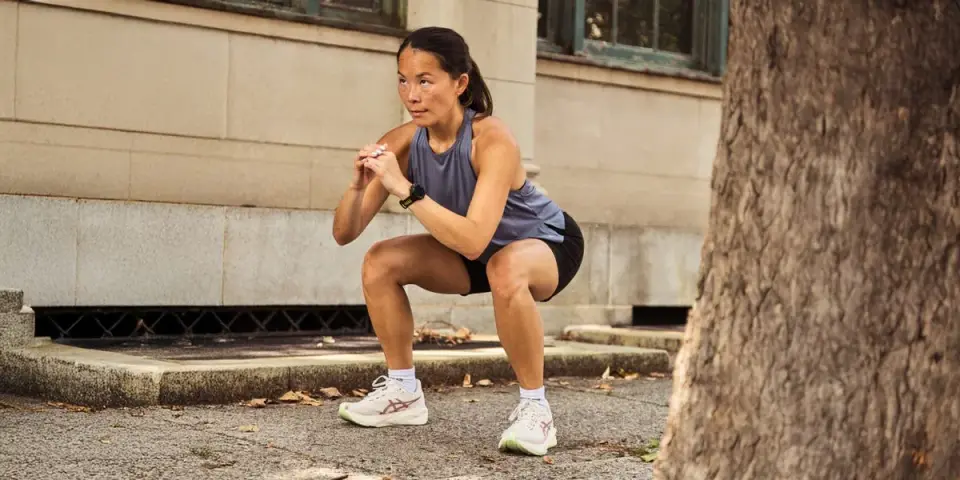
- Dumbbell squat. Feet hip-width apart, toes forward, a dumbbell at hip height. Lower slowly with a straight back, heels glued to the floor. Don't let your knees fall in or pull out. Avoid deep squats for now.
- Romanian deadlift. From the same stance, send your hips back so your torso tips forward until the weight reaches your shins. Rise slowly, heels down.
- Controlled step-down. Slowly lower one foot from a step to the floor, keeping the standing knee from caving inward.
Find more moves in our guide "Strength training for runners: 7 exercises twice a week". Keep doing them after the pain is gone: strong muscles are what stop the injury from coming back.
How to prevent knee pain
- Increase volume and intensity gradually, not in jumps.
- Warm up with about five minutes of light activity before you run.
- Work on your form: a slightly quicker, shorter stride moves your landing closer to the midfoot. More in "Running form for beginners: 7 tips and how to raise cadence".
- Keep your quads, hip flexors and calves flexible.
- Take breaks when you sit for long periods — get up and walk so your knees don't stiffen.
- Run in comfortable shoes designed for running.
- If you carry extra weight, even a modest loss reduces the stress on your knees.
When to see a doctor
See a professional if the pain doesn't improve within a few days, the knee swells or becomes hard to bend, sharp pain stops you mid-run, or you struggle to walk comfortably. Knee pain can have other causes, so an accurate diagnosis matters.
This article is for information only. If you have knee pain, consult a doctor or a sports physiotherapist.