November 20, 2026
- Recovery
- Training
- Running
Stretchingafterrunning:6stretchesandhowlongtohold
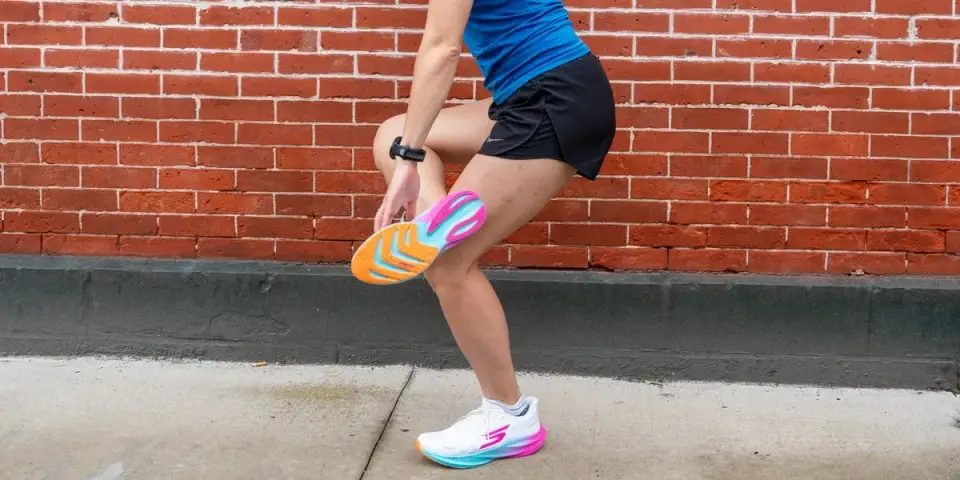
Plenty of runners head straight for the shower after a run, while others spend ages stretching cold muscles before they start. Neither is ideal. Stretching does help you keep your flexibility and joint range of motion, but when and how you do it matters. Here is what to do before a run, which stretches to do afterwards and how long to hold each one.
Should you stretch before or after running?
The short answer: a dynamic warm-up before, static stretching after.
- Static stretching means lengthening a muscle and holding the position. Right before fast running it can temporarily reduce force and speed, because the muscle is slower to fire. Stretching cold muscles also raises the risk of microtrauma.
- A dynamic warm-up uses active movements without long holds: leg swings, butt kicks, high knees. It warms the muscles, raises your heart rate and body temperature, and primes your brain to coordinate running movements.
Save static holds for the end of the session, when your muscles are warm and the stretch goes deeper and more gently.
Pre-run warm-up: 3 dynamic moves
Walk briskly or jog easily for 5–10 minutes first.
- Frankenstein walk. Stand tall, kick your straight right leg forward and tap the toes with your left hand. Lower it, step forward and repeat on the other side. Keep going for 30 seconds. Especially useful for tight hamstrings.
- Quad + glute walk. Pull your left heel towards your glutes, release, step forward and switch legs for 30 seconds. Then alternate cradling each knee up to your chest for another 30 seconds.
- Inchworm. Bend forward to touch the floor, walk your hands out to a high plank, hold for 2 seconds, walk your feet up to your hands and roll up. Repeat for about a minute.
Post-run stretching: 6 stretches
Do these right after your run and cool-down. The areas that most often feel tight are the calves, hamstrings, hip flexors and the outside of the thigh.
- Standing quad stretch. Shift your weight onto your right leg, grab your left foot and gently pull it towards your tailbone. Keep knees aligned, pelvis tucked and don't arch your back.
- Kneeling hip flexor stretch. Kneel on your left knee with your right foot in front, knee and ankle at about 90°. Lean your hips forward, engaging your core and glutes, with your chest lifted.
- Lying hamstring stretch. Lie on your back, loop a strap or band around your right foot and keep your left leg straight on the floor. Raise the right leg until you feel a light stretch along the back of the thigh.
- Figure-4 stretch. Lying on your back with knees bent, cross your right ankle over your left knee. Hold behind your left thigh and pull it gently towards you.
- Knees to chest. Lying on your back, hug your bent knees and gently pull them towards your chest to release the lower back.
- Child's pose. From all fours, sink your hips back onto your heels, lower your chest towards the floor and reach your arms forward.
How long to hold and how often to stretch
- Hold each stretch for about 30 seconds per side and breathe normally. Particularly tight areas may need up to 60 seconds.
- An alternative: 3 sets of 15-second holds, easing off for 5 seconds between sets.
- Consistency beats duration: aim for at least 2–3 times a week. Even 5–10 minutes at a time helps. Stop stretching and your range of motion will gradually slip back.
5 rules for safe stretching
- Don't bounce. Move smoothly — bouncing can injure the muscle and add to tightness.
- Tension, not pain. If it hurts, you've gone too far: ease back to a comfortable point.
- Aim for symmetry. Forget gymnast-level flexibility; what matters is that both sides are equally flexible. An imbalance may be an injury risk factor.
- Stretch your running muscles. Calves, thighs, hips and lower back do the most work.
- Don't stretch an injured muscle. With a strain, stretching can make things worse.
What stretching won't do
Stretching improves flexibility and range of motion, but it isn't a magic fix. Research doesn't show that it meaningfully reduces post-exercise muscle soreness, and it won't prevent overuse injuries, which are more often caused by sudden jumps in mileage. So pair it with strength work: 7 strength exercises for runners, twice a week. And for what actually helps sore calves, read “Massage gun or ice after running”.
If you have a chronic condition, an injury or pain that doesn't go away, talk to your doctor or a physical therapist before you start stretching.