November 2, 2026
- Training
- Research
- Half Marathon
- Marathon
Howtopredictyourhalfmarathonandmarathontime:RiegelandVDOTexplained
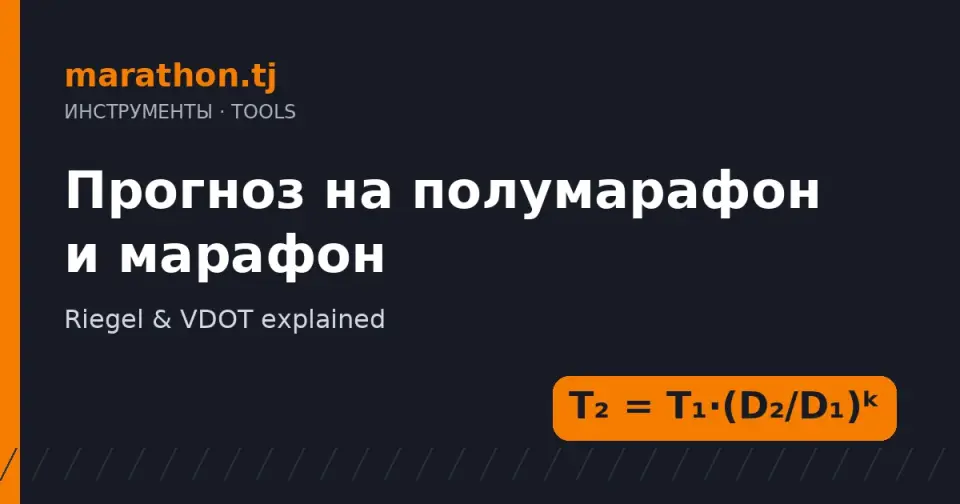
Want to know how long a half marathon or marathon will take you before you have ever run one? There are proven ways to estimate it from a shorter race.
The Riegel formula
In 1977 engineer Peter Riegel proposed a simple relationship: T2 = T1 × (D2/D1)^1.06. The 1.06 exponent reflects that pace drops a little as distance grows. For 10 km in 50:00 it predicts a 1:50:19 half marathon and a 3:50:01 marathon.
The cautious version
Many amateurs slow down more in the marathon than 1.06 suggests, especially on low mileage. So the marathon.tj predictor also shows an exponent of 1.10: half marathon 1:53:40, marathon 4:03:39. For shorter distances this column is faster instead (5 km 23:20 vs 23:59), because the exponent works in reverse.
Daniels VDOT
In Oxygen Power (1979), Jack Daniels and Jimmy Gilbert built tables linking race results to a notional aerobic capacity, VDOT. A 50:00 10K equals VDOT 40, with equivalents of 24:06 for 5 km, 1:50:52 for the half and 3:49:40 for the marathon.
Which prediction to trust
If you do regular long runs and run 4–5 times a week, use Riegel or VDOT.
If it is your first marathon or your mileage is low, use the cautious figure.
The best input is a recent result close to the target distance: a marathon prediction from a half is more accurate than one from a 5K.
Train by your VDOT
For VDOT 40 the calculator suggests easy 6:59–5:51, marathon 5:30, threshold 5:06, interval 4:40 and repetition 4:25 per km. Turn your target time into a per-km plan with the pace calculator. Preparing for your first half? Read "Half-marathon training mistakes".