October 29, 2026
- Marathon
- Records
- Races
- Stories
AbebeBikila:barefootthroughRometoOlympicgoldandaworldrecord
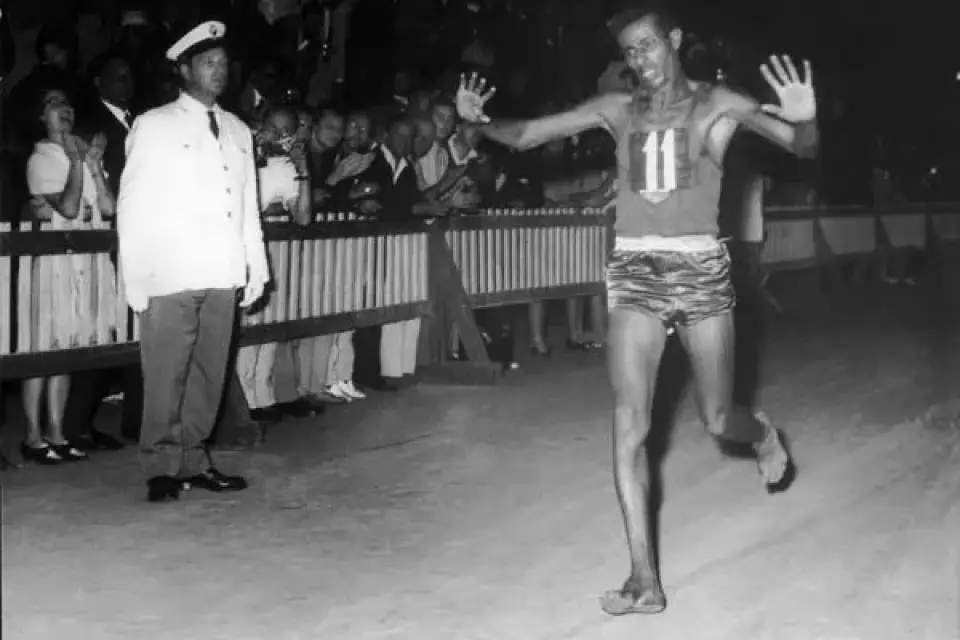
On the evening of 10 September 1960, 69 runners from 35 countries lined up for the Olympic marathon in Rome. World record holder Sergey Popov of the Soviet Union was the favourite, and almost nobody had heard of the slender Ethiopian Abebe Bikila. Two hours and fifteen minutes later it was Bikila who crossed the finish line first at the Arch of Constantine, barefoot and in a world best time.
From herder to Imperial guard
Bikila was born on 7 August 1932 in the village of Jato in Ethiopia and worked as a cattle herder as a boy. A trip to Addis Ababa changed his life: after watching the Imperial Body Guard train, he joined it at 19. The guards were encouraged to exercise hard, and Abebe quickly found he had a gift for running. He started out at 5000 and 10,000 metres and made his marathon debut in 1959 at the Military Forces Day celebrations.
Swedish coach Onni Niskanen, then Ethiopia's director of athletics, gave him a structured training programme. A month before the Games, Bikila won the national trials in Addis Ababa, at an altitude of more than 2400 metres, in 2:21:23, faster than the Olympic record at the time.
Why barefoot
Under Niskanen, Abebe had trained both with and without shoes. But in the final days before the race in Rome his shoes fell apart, and a new pair gave him blisters. So he decided to run the biggest race of his life barefoot. If you are choosing shoes for your own running, our complete guide to choosing running shoes may help.
The race started at 5:30 pm to avoid the heat, yet it was still around 23°C, and hundreds of Italian soldiers lit the course with torches after sunset. After 20 km two Africans, Bikila and Morocco's Rhadi ben Abdesselem, broke away. About 500 metres from the finish, at Piazza di Porta Capena, where the Obelisk of Axum taken from Ethiopia after the Italian invasion of 1936 stood, Abebe made his decisive move. He finished in 2:15:16.2, 0.8 seconds faster than Popov's record. Abdesselem was 25 seconds behind, and New Zealand's Barry Magee took bronze.
A second gold and a legacy
In Tokyo in 1964 Bikila, this time wearing shoes, won the Olympic marathon again in a world best of 2:12:11.2, by more than four minutes, just 40 days after having his appendix removed. He became the first person ever to defend the Olympic marathon title. Between 1960 and 1966 Abebe won 12 of the 13 marathons he completed; his only defeat was fifth place in Boston in 1963.
At the 1968 Games in Mexico City he withdrew injured after 17 km. In 1969 Bikila was paralysed in a car accident, yet he still competed in archery at the Stoke Mandeville Games, the forerunner of the Paralympics. He died on 25 October 1973, aged 41. World Athletics calls him the first global East African champion, the man who opened the way for generations of distance runners. For Tajikistan's own Olympic marathon history, read our story about Gulsara Dadabayeva.
Common questions
An Ethiopian marathon champion and Imperial Body Guard runner who became the first Black African Olympic gold medallist in 1960 and defended the title in 1964.
In Rome his shoes fell apart and a replacement pair blistered him, so he raced barefoot — and still set a world best.
2:15:16.2 — a world best in 1960, finishing at the Arch of Constantine.