November 17, 2026
- Running
- Recovery
- Research
TrailvsRoadMarathon:WhichOneHurtsYourLegsMore?
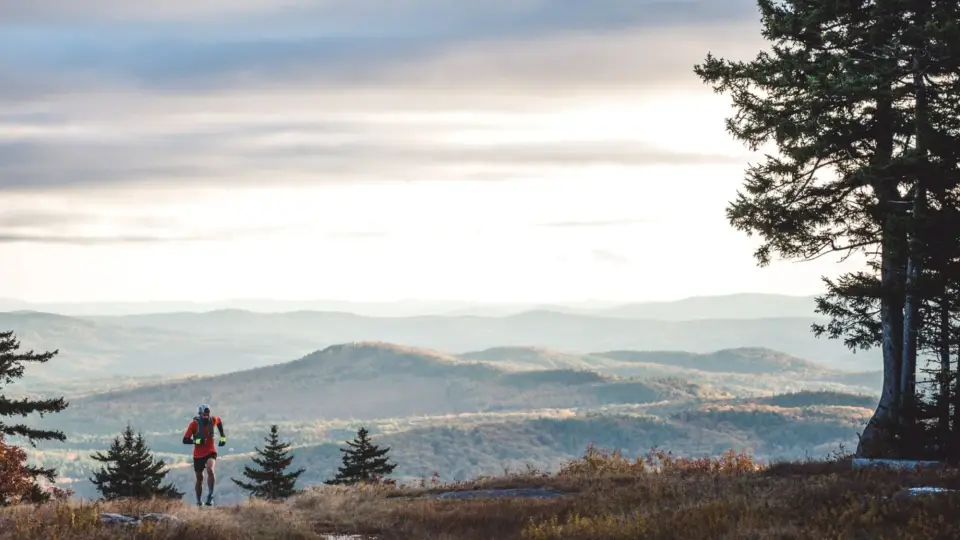
It seems obvious that a mountain marathon with steep climbs and descents should wreck your legs more than flat tarmac. A new study by French trail running researchers found the opposite: after a road marathon, muscles were more damaged and took longer to recover.
How the study worked
Forty-six runners took part. Sixteen road runners completed a simulated marathon (about 42 km) on a treadmill. Trail runners were split into two equal groups: one ran a mountain marathon on an inclined treadmill, the other ran a real trail outdoors. The trail course was 28 km with 1,400 m of climbing and the same amount of descent. To make the efforts comparable, the researchers used a rule of thumb: every 100 m of climbing equals an extra kilometre of flat running.
Leg strength, jump height, muscle soreness and a blood marker of muscle damage (creatine kinase) were measured before the start, right after the finish, and 1, 2 and 7 days later.
What they found
- Quads weakened more after the road marathon. The road group lost more front-thigh strength, and the deficit was still there two days later.
- Creatine kinase was markedly higher after the road marathon, a sign of more muscle micro-damage.
- Soreness followed a similar pattern, though the gap was smaller.
- Calves were affected about equally in all groups.
- There was almost no difference between trail running on the treadmill and outdoors, suggesting that the hills, not the rough terrain, make the difference.
Why roads are harder on muscles
The main explanation is repetition. On a flat course every stride is like the last, so the same muscle fibres fire thousands of times in a row. In the mountains your stride keeps changing between climbs, descents and flats. Hills also force you to slow down and sometimes walk, and a slower pace means less load on the muscles.
That is also why the long descents on the trail did not destroy runners' legs: on uneven terrain you cannot hold a fast pace for long, unlike on a smooth, gradual road descent.
Limitations
The groups were not randomised: road runners were used to roads and trail runners to mountains, so trail runners' legs may simply be better conditioned. Also, the road marathon took 3:54 on average versus about 3:00 for the trail marathons. A longer run alone could cause more damage, so the findings are best treated as a strong hypothesis rather than proven fact.
What it means for you
- After a road marathon, plan at least 2–3 days of full or active rest: your quads need longer to recover than you might think.
- Vary your long runs. A hilly route or trail changes the load and is probably kinder to your muscles than kilometres of flat tarmac.
- Don't chase pace on descents. Running fast down a smooth road is one of the main causes of trashed thighs.
- In Tajikistan's mountains, account for altitude: before a trail race such as Seven Lakes it is important to acclimatize properly.
- For calf recovery after a long run, see what works better: a massage gun or ice.
This article is for information only. If muscle pain lasts more than a week or gets worse, consult a doctor.